Monday, October 31, 2011

LAD #10- Monroe Doctrine


"The Monroe Doctrine was expressed during President Monroe's seventh annual message to Congress, December 2, 1823:" It stated that the United States would not stand for any oppression brought on my existing European colonies in America. If any such violence or oppression was present then the United States would act with agression to put it down. European nations were forbidden to interfere with the United States any further which also meant that no additional colonization of the "New World" was to take place. Especially with the newly independent and somewhat shaky America, interference of any sort was dangerous. Additionally, Russia and Great Britain were now maintaing peaceful relation to America. Both countries, as well as America, believed that the whole of European nations should cease colonization and oppression of other counrties, and concentrate on their own domestic affairs. The United States also declared that they would not interfere or attempt to colonize any European nations. The Monroe Doctrine ultimately allowed the United States to become fully independent without fear of being taken over once again. The United States was then able to flourish without the looming shadows of European superpowers who would jump at the chance to dominate the country.

Tuesday, October 11, 2011

LAD #9: Jefferson's First Inaugural Address

In the beginning of Thomas Jefferson's First Inaugural Address he first thanks the American people and expresses his gratitude in being voted as President. He also acknowledges the difficulty of the job he has taken on but promises to do the best he possibly can and that he was ready to take on the role as President. He goes on to stress his desire for the country to succeed and move forward in the next few years which can be done with the aid of the American people as well as the Constitution. He claims that America will continue to be the strongest nation in the world while maintaining it's sense of security and improving itself for the future. Jefferson declares that he wants to stay away from the issues plaguing Europe and remain uninvolved. In essence, he would follow the guidelines of a Republican government in order to retain the strength and stability of the government that presently was in place. Following the basis of a Republican government would aid America in reaching its goals and bettering itself for the future. He concludes, yet again acknowledging the difficult task that lies before him but promises to learn from his mistakes and lead America in being the best that it can be for he is there to serve the country.


Monday, October 10, 2011

Columbus Blog #8


Today, the immoral acts that were committed by Columbus in the founding of America are almost never remembered in comparison to the happiness that many associate Columbus Day with, in having a day off from school or work. Many do not remember the horrors that Columbus brought to the Indians of the New World and of the impacts of his voyage. The primary reason for his voyage was to find new trade routes to the East Indies which would bring him more wealth and fame. However, although he ended up finding the New World, he still received the wealth, fame, and glory he was searching for, each being a variation of the greed that consumed Colombus in his expeditions. On his first expedition he encountered the Arawak people of the Bahamas which he believed were very vulnerable and could easily be converted to Chrisitanity and taken as slaves. He even said "I could conquer the whole of them with 50 men, and govern them as I pleased." This shows his power hungry mindset and that he was leading these voyages in order to solely benefit himself. On later expedition similar events occurred. Columbus would accept the gifts and services that he was given by the Indians, just to take their land, convert them to Christianity and use them as slaves. Additionally the disease brought to the New World by Columbus and his men took countless lives of the Indians.  He obtained much wealth from the Indians themselves and also from monarchs who paid him to carry out these expeditions. Columbus should be remembered as a villain but by most people today, Columbus is recognized as the hero who founded America resulting in a three day weekend.

Thursday, September 29, 2011

Republican Motherhood Blog

1.) What role did the Revolutionary War play in the transformation of housewifery to Republican Motherhood?

The war allowed the roles of housewifery to expand. Before the mindset was focused on raising children and taking care of the home, however later expanded into "training good citizens." The most important roles of housewives who were now in the transition to Republican Mothers was to guide her children "along the pleasant paths of knowledge." (Doc A) Also, there was an increasing push for the education of women although the subjects studied were never in depth. The main purpose in educating these women was so that they could pass on the knowledge that they possessed to their sons. (Doc B)

2.) What were the consequences of Republican Motherhood on women?

The consequences were that there was a higher expecation of women to take care of the home and most importantly pass on their educations to the children. Women may have at times considered this a great burden as "she may never herself step beyond the threshold" of her home. According to Jonathan F. Stearns, in the Discourse on Female Influence, the "fate" of the country was solely in the hand of women and the decisions they made. (Doc D)

 3.) What is the signifcance of the ideology of Republican Motherhood as a stage in the process of women's socialization?

It was believed in Thoughts Upon Female Education by Benjamin Rush, that the stage of Republican Motherhood would encourage a furthur education in order "to prepare [women] for the duties of social and domestic life." Also with this education a woman could properly socialize and educate her children in order to later benefit the world when they became adults.

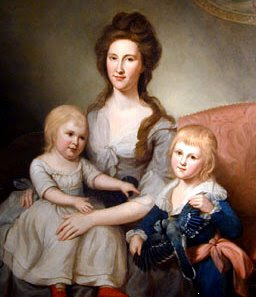
1.) The setting of this portrait is in the home, where women spent their time caring for the children and the house. The clothing of the subjects, most clearly the little boy in blue implies that the family has spome wealth. The couch and the picture frame in the background also may lead one to this conclusion.

2.) The little boy in blue servces as the center of this poaiting as evidenced by the emphasis with light on the figure. He serves as the center because it emphasizes the main role that women had in the household during the time which was caring for her children. The woman looks content to be with her children. There is an air of calmness around her. She looks republican rather than aristocratic because of the clothing she is wearing and the sole fact that it is her caring for her kids and not a nanny. She looks happy to be there which implies the relatiponships she has with her children as well.

3.) Her sons exhibit values of sophisitcation and calmness, like their mother. Even in the way that the boy in blue is standing, implies that he is patient, traits that were probably taught by his mother.

4.) It looks as though her arm is separating the two boys and the light on one but not the other suggests that one boy is more important. It may be that the boy in blue represents the effects of a republican mother on society, while the other boy represents the past effects before republican motherhood. However, her arm could also be interpreted as the loving arm of a mother who possesses and intense care for her children.

Wednesday, September 28, 2011

LAD #7: Washington's Farewell Address

In Washington's Farewell Address, Washington focused on the point to avoid political parties which he believed would split up the country and lead to disunity. He was a strong advocate for national unity throughout his presidency. He believed that without unity, the future success of America would not be possible. Washington also stressed that America should pursue of a policy of isolationism and remain neutral in forgein affairs. In the end, he was very grateful to the people and many were sad to see him leave.

LAD #6: Washington's Proclamation of Neutrality

Washington's Proclamation of Neutrality stated that the U.S. would maintain friendly relations with each of the powers involved in the war against France which included Austria, Prussia, Sardinia, Great Britain, and part of the United Netherlands. It also stated that if any person disrespected these friendly relations then the U.S. would discontinue to protect them and additional punishments would be carried out.

Tuesday, September 27, 2011

LAD: Federalist #10

1. Why are factions so difficult to eliminate?

Factions are difficult to eliminate because they origniate from liberty. They are few solutions in dealing with factions as the options are limited to forcing all the people to believe in the ideas of one faction or to eliminate liberty in a faction. Both are completely outrageous solutions which would probably never sustain any sense of order.

2. If factions cannot be removed then how can they be controlled?

Although factions are accepted as things that are almost impossible to be eliminated, if the faction is smaller in size then they will allow for more control. Also, by attempting to break large factions into smaller factions will again provide for more control. The use of the government to one's advantage will help one also take the majority of the people to one's advantage.